Monday, 15 June 2026

Reflections on a Graduate "Research Commercialisation" Course: A Divergence in Values and Perspectives

[Note: This was written and submitted as a review for a previous course I took during my PhD. I am motivated to share it here now.] 


Thank You for offering this course. Upon reflecting on my recent experience with the commercialization course, I have come to a

conclusion that many of the processes involved in commercialization presented in this course

do not resonate with my own views and values regarding the intrinsic worth of research. This

insight has compelled me to critically examine the fundamental differences between my

perspective on research and the broader framework of invention and discovery.


At the core of my conviction is the belief that research possesses intrinsic value independent of

its commercial potential. My intent has always been to explore the nuances of my research,

particularly the small fraction that might be combined with existing problems to evolve into

tangible products. However, throughout the course, I grappled with a disconcerting realization:

this mindset can be limiting. The course's framework implies that the only valuable outcomes

of research are those that can be packaged, marketed, and sold, which feels reductive and may

ultimately stifle the exploration of valuable research avenues that lack immediate

marketability.


Moreover, I found the concept of pitching ideas from a position of ignorance within a short time

span particularly challenging. I value comprehensive education and am critical of

overspecialization that sacrifices broader expertise. It is hard for me to believe that investors

themselves would not want to be informed on the technicalities of a project, as these details

constitute competitive advantages and can reveal "potential emergent cracks in the product." I

had been educated to expect insights, even from the non-expert, to be still essential for making

informed decisions, yet the course seemed to advocate a more superficial engagement with

complex topics. This is understandable for say a high volume or workload but seems to assume

that investors have less time to engage themselves in developments than the people pitching

these developments to investors. Why is there this asymmetry?


A critical aspect of this commercialization framework is the notion of "hiring a product to do a

job for you." This concept, while appealing in its simplicity, overlooks the complexities and

uncertainties inherent in fundamental research and engineering. Products, like any other

human endeavor, can fail; they are not fail-safe solutions that can be simply deployed to

address problems. The expectation that a product can seamlessly resolve an issue belies the

reality that many breakthroughs emerge from failures and continuous iterations. Even primitive

knives may have derived from the shrapnel of larger more cumbersome hand axes in the stone

age. Did the cavemen then hire the knife or simply develop it from what was simply a

happenstance by-product? This tension between the ideal of product utility and the

unpredictable nature of research and components as they come about in time is a crucial

critique of the commercialization mindset. It suggests that, rather than viewing research as a

pathway to a product, we should recognize it as a process of discovery that may not always

yield immediate or marketable results.


The course’s emphasis on market-driven decision-making struck me as particularly troubling.

By prioritizing commercial viability, we risk neglecting the deeper, transformative aspects of

research that do not conform to a business model. Equating research and development with

marketing creates a false equivalence; marketing, in its essence, seems more a means to an

end than the serious, substantive process of fundamental research that seeks to expand our

understanding of the world. The commercialization framework often implied that the value of

research is determined by its market potential, thereby undermining the true spirit of inquiry

and discovery that drives scientific advancement.


While I acknowledge that some aspects of the course provided valuable insights, I am grateful

for its brevity. Designed to be accessible to beginners—including those like myself who have

never fully grasped the mindset of an investor—the course presented an intriguing yet narrow

perspective. Engaging with the content only deepened my interest in alternative funding

mechanisms, particularly public funding. This interest stems from a desire to understand how

different funding models operate, especially in the context of large infrastructure projects

reliant on research. I am curious about how these projects prioritize diverse deliverables and

the implications of developmental timelines.


One of the key reflections I took from this course centers around the emphasis on the timeline

for product development. The course posits that marketing primarily concerns the fine-tuning

of ideas that have emerged from years, if not decades, of fundamental research. This

framework suggests that innovation is merely a refinement of existing concepts, rather than a

process that can start with entirely new ideas. This notion is disheartening, as it seems to stifle

creativity and discourage the exploration of groundbreaking concepts that may not fit neatly

into the commercialization narrative.


In my view, the true essence of research lies in its capacity to challenge the status quo, provoke

thought, and inspire new ways of thinking. It thrives on curiosity and the pursuit of knowledge,

often leading to discoveries that cannot be easily quantified or monetized. The emphasis on

commercialization in the course places a premium on immediate results and practical

applications, overshadowing the profound importance of fundamental research that may take

years or even decades to bear fruit. When we hire a product to do a job for us, we risk reducing

research to a transactional endeavor, prioritizing short-term gains over long-term exploration.

As I reflect on my experience in this course, I am reminded of the critical role that fundamental

research plays in driving true innovation. It is the exploration of the unknown, the questioning of

established norms, and the willingness to take risks that often lead to the most significant

breakthroughs. By focusing solely on the commercial aspects of research, we risk losing sight

of the bigger picture—the potential for transformative discoveries that may not fit neatly into a

market-driven framework. Research to is, I realize more than ever, in fact the opposite of

neatness.


Moving forward, I am compelled to seek out opportunities that align more closely with my

values and beliefs about research. I am particularly interested in exploring how public funding

operates and how it can support innovative projects that prioritize discovery over immediate

commercial outcomes. I believe a deeper understanding of these funding mechanisms can

shed light on how we can better support research initiatives that may not have immediate

market appeal but hold the potential for significant societal impact.


In conclusion, my experience with the commercialization course has been both enlightening

and affirming. While I appreciate the insights gained regarding the investor mindset and the

commercialization process, I am ultimately more inclined to advocate for the intrinsic value of

research and the importance of fundamental inquiry. True innovation does not arise from the

confines of commercial viability but from the spirit of exploration and the relentless pursuit of

knowledge. As I continue my journey in research, I remain committed to fostering an

environment that values curiosity, creativity, and the profound impact that fundamental

research can have on society—one that recognizes that not every product can or should be

hired to do a job for us.

Tuesday, 27 February 2024

Thoughts on a Resilient Network Model of Learning Delivery and General Education

Introduction

In this writing I wish to outline a teaching philosophy based on a model of teaching with the concept of resilience in mind. What this means is a forging a framework as a dynamic and adaptive system of learning based on generating learning materials from a subject curriculum, reflecting on the work resources created and forming active links of information exchange between the reservoir of material and the learning goals of an individual student and student community, links that have the capacity to be changed, updated and/or given new avenues to further learning all the while being adaptive enough so that the student community is bolstered and made resilient themselves to make behavioral changes in response to outside shocks. This, I am convinced, is a reasonable way to ensure that local and global changes to learning routines are not disastrous to the overall protocol of education. 

Resilient Model of Learning Delivery 

Teaching can be defined as an action that conveys a meaningful exchange of information, using work done by the teacher and the student community, to give an impact that establishes links to educational material and students' ability to recall and use that material in a dynamic and coherent way to solve problems in a complex environment. The students must be linked with material, through education, on the stage of the complex environment itself and so the process must be a resilient one to external factors. Learning then is also about strengthening the links made in a given educational setting, i.e. a class, and making it transferable to another setting, such as a project, exam or work setting. The links we may want to make resilient are as varied as the curriculum itself, not limited to the ability to remember how to problem solve but to deconstruct information, construct models, share information or integrate new information. 

These links are made resilient within the educational process as they are practiced, refined, subject to shifts in priorities based on local and global factors or in fact broken and replaced/restored as need arises. A resilient educational process therefore must have structure, with a plastic and versatile memory, where the conventional focal point of education is established by the nature of the external complex society. This varies quite a lot given the nature of different societies across the world and across time, goal orientation and/or grade validation may not be the focus or purpose of education in one society but may have a local basis for existence in another. This is a way of saying goals can vary in the structure of society and a student's own goals, for example learning a trade or skill by “learning by doing” rather than pure theory. 

Any educational protocol that can call itself resilient must have its actions linked to outcomes that can take a form of measurable evidence to provide coherent feedback of the learning resources over the course of time. From raw evidence such as grading outcomes, sampling of students focus of learning materials (i.e notes, requests or download of study content over time etc.) as well as feedback a specific framework of reflection of learning outcomes, management of content, judgement and choices based on the delivery of the subject matter in class, examinations and projects can be created. This can form an adaptive memory of teaching a subject as the subject itself changes or as the student community changes or other unforeseen changes occur. In a resilient model, modifications to education delivery may be changed based on the measured changes, with certain links reflecting the action of delivery from a teaching resource to a student audience being broken, replace or switched from one strategy to another over time. 

Model Diagram

In this model, perhaps changes, or indeed shocks, to any learning delivery system are based on local factors in the class setting, greater university setting or global factors due to unprecedented events. 

  • In local cases we could have 2 scenarios: 


First, we could consider an individual student or student community engaged in learning behavior wherein they form a certain set of links to and from the learning resource material and the outcomes in a curriculum. Students as individual may see the curriculum as a well of sorts that has to be filled via resilient links that they would create to reach a certain level of mastery. 

Overall, a student community would be given an expectation to reach a certain level by the end of a class or course, for example as listed in a class/course syllabus. The links established in the curriculum may be treated as equal in an unchanging background but in an instance of an exam being scheduled or a group project proposed the student community and Indvidual's will form a shift in behavior in what links in the curriculum well will be favored and thus the links themselves must be made resilient enough to bolster this change in priorities. 

In a second example, a module may have an element that was in one year confined only to theory but based on a reflection generated by evidence gathered of learning outcomes in tandem with new learning resources being made available, old links from learning resources to class delivery are switched from being pure theory to theory and practical. This can cause changes that may, for example, go on to replace the theory component altogether in a fashion which may not have been considered without updating from a reflection. 


  • In global cases one can think of a very general set of scenarios: 

These scenarios would be global in scope, caused by changes in society, technology economics, job markets and unprecedented occurrences due to changing demographics, natural and human induced disasters, diminishing returns on growth and increased societal pressures. A model based on resilience is not an abstraction in these cases and in several instances one can think of education resources for instance having to be made streamlined, efficient but highly resilient. For example, during a natural disaster a course that was in the practical and hands-on domain may be moved entirely online and remote. Lets say students in first year learning practical electronic circuit building. 

Such a course may have had online simulation and theory resources were made previously available and would ideally have been made resilient enough to effectively be “switched on” and have the link between the resource and student acquisition strengthened via more active reflection so that the link would be resilient and be an avenue for learning goals that yield outcomes to feedback into further reflection and refinement over time. 


Final Statement 

The model I have described, and illustrated as a diagram below, is in many cases, fairly generative and is one that itself is a product of my own personal reflection and rumination about how to teach varied subject matter, mostly in the field of science, engineering and mathematics, in a highly complex and dynamic emerging local and global community. It is my sincere worldview however that resilient networks within institutional systems allow for resilient communities to be able to emerge and withstand local and global shifts behavior that is inherently risky but made safer to implement if the links between informational resources and active teaching is continually updated in an adaptive way.

Monday, 11 December 2023

Building Bridges between Synchronization and Quantum Entanglement in Networks


The similarities between so-called classical synchronization and quantum entanglement is not lost on some of the emergent, self-similar behavior, that exists in these systems. This can be seen in the systems themselves, separately. Perturbations in quantum systems lead to discontinuities that can lead to decoherence however systems of entangled quantum oscillators can also display error-correction in certain topological states, such as toric and/or surface codes. Classical systems meanwhile display so-called chimera states that exist as a "phase state" between order and disorder to an extent that these states can actually steer a self-organised system back from a chaotic edge and maintain itself durable. I have explored these concepts in a previous video: However here I wish to showcase some of the actual simulations I've done with software and hardware which does not necessarily take us into using the exotic systems found in a quantum optics lab. Metaheuristic algorithms meanwhile that port and parse some of the measurement spaces found in quantum systems, i.e. the Poincare/Bloch/Riemann Sphere and represent them as "squashed" pseudo-quantum states represented as HSV values say can nevertheless display some of the "quantumness" which can be described using, among other things, the path integral formalism of quantum mechanics and even resembles the behavior of real-world quantum states of matter such as entangled networks, Bose-Einstein condensates, currents and flows of Cooper pairs in superconductors etc. From all of this we could very well as, are all of these variations on a common physical theme? Another question we could ask in this research is, at what scale does entanglement end and synchronization begin and vice versa?

Sunday, 26 November 2023

Experiment in making Periodically-Poled KTP (ppKTP) for Quantum Optics Research using off-the-shelf KTP


a big focus of my research is buying bespoke optics components and repurposing them for quantum optics experiments and the relative abundance of KTP (potassium titanyl phosphate) along with micro electrodes motivated me (among others things) to try and see if current setups using BBO (beta-barium borate) can be enhanced with modified components that would otherwise be prohibitively expensive to integrate into existing systems. Measuring the degree of polarization-entanglement is the next step and it too uses a lot of off-the-shelf technology but, again, restructured for a different purpose. In many instances the research goal is to create new architectures in networks that already exist in the classical domain. As a point of fact a lot of my research has taken me into bridging classical networks and their components into the emerging field of "quantum" networks. In many ways the components for "quantum" networks already exist, the networks themselves just have to be tailored with a different approach than before.

Thursday, 20 October 2022

Capturing Emission Spectra from a Lightning Bolt during a Thunderstorm i...


I've always wanted to see if I could capture at least a low resolution image of emission spectra from a clear shot of a lightning bolt using a diffraction grating and a camera and a thunderstorm last night presented a rare opportunity to test this idea!


Monday, 4 April 2022

Drone Environmental Monitoring of The Bandama Caldera Thermophilic Forest - Using Python for NDVI, ENDVI, SAVI Image Processing

In a recent trip to Gran Canaria, I visited one of my favorite natural landscapes there; the Bandama Caldera which hosts a diverse variety of plant and animal life. Since the weather was clear and the illumination was good I decided to deploy my drone to perform some visual inspection and near-infrared environmental monitoring with NDVI, ENDVI and SAVI metrics extracted using my github codes:https://github.com/MuonRay/PythonNDVI


Using my freely available (free for non-profit use) Python codes I can convert near-infrared images captured using my modified NIR camera with my custom made filters to perform remote sensing using my drone. I am continually working on refining the method and analysis of performing NDVI in the field and will soon be able to perform the analysis in real time using my phone which can run my python scripts using a mobile app. I hope to showcase this soon in a future video.

Thursday, 3 February 2022

Quantum Encryption of Images in Python using Bitwise XOR and a QRNG


XOR Cipher in Standard Cryptography

In Cryptography, the exclusive OR or XOR Cipher is an additive method of encryption of a string of data using a particular key.

The XOR operator is extremely common as a component in more complex ciphers. By itself, using a constant repeating key, a simple XOR cipher can trivially be broken using frequency analysis for pattern recognition as a means to reconstruct the key generation process, if not made using a Pseudo-Random Number Generator for instance. If the content of any message can be guessed or otherwise known then the key can be revealed.

The primary merit of the XOR Cipher is that it is simple to implement, with the XOR operation being computationally inexpensive. 

The XOR Cipher itself can be implemented using a XOR Logic Gate in a Bitwise Function.

an encryption algorithm that uses the XOR operates according to the principles:

 0 = A,
 A = 0,
 B = B  A,
(A  B)  C = A  (B  C),
(B  A)  A = B  0 = B,

where  denotes the exclusive OR (XOR) logic operation. This operation is sometimes called modulus 2 addition (or subtraction, which is identical). With this logic, a string of text can be encrypted by applying the bitwise XOR operator to every character using a given key. 

To decrypt the output, merely reapplying the XOR function with the key will remove the cipher, as the XOR operation is its own inverse.


In any of these ciphers, the XOR operator is vulnerable to a known-plaintext attack, since 

plaintext  ciphertext = key.


If the key used is random, then the XOR operation will in a sense preserve the randomness of the key in the encrypted data. The result is a random stream cipher. If a key is generated using a truly random number source, such as a quantum random number generator, the result is the generation of one-time pad using a single use, truly unique key that is in principle impossible to crack. This is the motivation for generating QRNGs which can combat the emergence of quantum computation that could, in principle, perform known-plaintext attacks of stream cipher encryption in polynomial time. Quantum Encryption is the only known way to combat this threat.

We can examine 2 methods to create encryption keys: using a Quantum Random Number Generator and by Using quantum correlated images captured using entangled photons.


Quantum Random Number Generation

As previously discussed, the random stream XOR cipher can be generated using a random number generator. pseudo-random number generators (PRNGs) are build on algorithms involving some kind of recursive method starting from a base value that is determined by an input called the "seed". The default PRNG in most statistical software (R, Python, Stata, etc.) is the Mersenne Twister algorithm MT19937, which is set out in Matsumoto and Nishimura (1998). This is a complicated algorithm, so it would be best to read the paper on it if you want to know how it works in detail. In this particular algorithm, there is a recurrence relation of degree n, and your input seed is an initial set of vectors x0,x1,...,xn1. The algorithm uses a linear recurrence relation that generates:

xn+k=f(xk,xk+1,xk+m,r,A),

where 1mn and r and A are objects that can be specified as parameters in the algorithm. Since the seed gives the initial set of vectors (and given other fixed parameters for the algorithm), the series of pseudo-random numbers generated by the algorithm is fixed. If you change the seed then you change the initial vectors, which changes the pseudo-random numbers generated by the algorithm. This is, of course, the function of the seed.

Now, it is important to note that this is just one example, using the MT19937 algorithm. There are many PRNGs that can be used in statistical software, and they each involve different recursive methods, and so the seed means a different thing (in technical terms) in each of them. You can find a library of PRNGs for R in this documentation, which lists the available algorithms and the papers that describe these algorithms.

The purpose of the seed is to allow the user to "lock" the pseudo-random number generator, to allow replicable analysis. Some analysts like to set the seed using a true random-number generator (TRNG) which uses hardware inputs to generate an initial seed number, and then report this as a locked number. If the seed is set and reported by the original user then an auditor can repeat the analysis and obtain the same sequence of pseudo-random numbers as the original user. If the seed is not set then the algorithm will usually use some kind of default seed (e.g., from the system clock), and it will generally not be possible to replicate the randomisation.


Using a Quantum random number source allows for much greater security as we can create numbers that are irreducibly random. Using a quantum-entanglement photon source based on the Beta-Barium Borate non-linear crystal, we can configure photo detectors that can detect the H and V modes of pair of entangled 810nm photons, These photons will be in superposition until the moment they are detected and so will represent the perfect 50/50 coin toss.  


The setup is showcased in the following video:


Entangled Photon Imaging


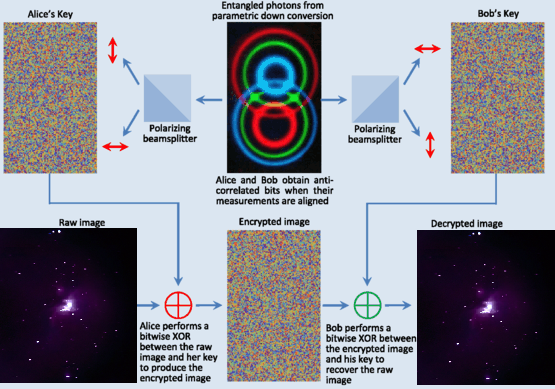
The diagram below showcases the scheme for quantum encryption using images of entangled photons processed using bitwise XOR on any image we want to encrypt using a shared quantum key distrubted between 2 users, Alice and Bob. 

Each recipient recieves the relative  anti-correlations to each other and so can encrypt or decrypt their transferred image in a one time pad use.
XOR Quantum Encryption Using Entangled Photons

using a CCD with a large enough sensor we can image pairs of entangled photons at 810nm using a narrow single-band pass filter at around 800-830nm


Quantum image encryption and decryption


Images contain information in both the form of metadata on the conditions the image was captured and in the pixel data itself. Metadata can be encrypted as a data stream so we will refer to image encryption as encryption of the pixel information itself from this point.

The definition of image encryption is an extension of data encryption in general: through the bitwise XOR operation of the original image pixels and the key image pixels, with the key image being either a pseudo-random stream cipher or the quantum random stream cipher or anti-correlated entangled information shared over a secure channel.


In either case we Perform bitwise XOR operation on the encrypted image and the key image.


It can be seen from the image encryption and decryption that they are all the same operation.


We now stipulate that the literal symbol of XOR is xor. According to the above bitwise XOR operation, we assume:


xor(a,b)=c


You can get:


xor(c,b)=a


Or:


xor(c,a)=b


In summary, we assume that a is the original image data and b is the key, then c calculated by xor(a,c) is the encrypted ciphertext. 

In summary:


Encryption process: Perform a bitwise XOR operation on the image a and the key b to complete the encryption and obtain the ciphertext c.


Decryption process: Perform a bitwise XOR operation on the ciphertext c and the key b, complete the decryption, and get the image a.


We can use our quantum random numbers generator in 2 ways to create our image encryption key:


(1) as a random number generator seed source

(2) using the random superposition of the H and V modes


We can also use the shared set of correlated images, captured using the single CCD, from our entangled photon source with Alice getting one half and Bob getting the anti-correlated half. This provides the perfect key, with the quantum images shared over a separate channel hidden from the encrypted classical images.


The file exchange channel is 2 way:


Alice can use Her key to encrypt the image, Bob can use His key to decrypt the image

OR

Bob can use His key to encrypt the image, Alice can use Her key to decrypt the image.


The XOR Cipher in this use can also be extended as a component in more complex overlay network ciphers if need be however for computational efficiency it is not necessary. It is just as effectual to have 1 quantum cipher as many, so in effect the system is completely hidden, by virtue of hidden variables, and is encrypted in an information condensate.


We can use my suite of image analysis plots to perform histogram analysis and construct a correlogram to try and do a routine check to see if the image encryption could be vulnerable to frequency analysis from the encrypted image pixel data:


Afterward:


Encryption of information, in particular visual information in the form of images and video, is of ever increasing importance online. Encryption of image metadata can be accomplished in tandem with encryption of pixel data to make for a more robust as well as computational inexpensive process using the XOR cipher combined with quantum RNGs and anti-correlated quantum information generated via entanglement sources. 

Research is also ongoing to use a variety of different entanglement sources, both optical (using Non-linear crystals) and in the Microwave Domain (using Josephson Junctions) with the goal being a many spectrum approach to secure information transfer. 

This would allow, among other things a secure, quantum entangled channel transferring the anti-correlated entangled key to operate on a separate band from the wavelengths used to generate the entangled key for instance. 

Moreover although line-of-sight optical communication has had much fanfare it sees that the microwave band still offers superior connectivity in telecoms infrastructure and will most likely be the focus of further generations of secure data transfer in mobile applications. Quantum Encryption therefore is a key niche in this area and XOR-based ciphers will be the fastest to implement in terms of wireless/non-fiber secure quantum communication. 


Github Files:


https://github.com/MuonRay/Quantum-Encryption-of-Images-using-Bitwise-XOR-and-QRNG