In this short experimental demonstration, I share a concept of induced ion propulsion using positive ions that create a wind that can push a thin-film of graphene that is kept levitating at effectively zero-G using a rare-earth magnetic track. This is, in effect, an ion "E-sail" (electric sail) that can capture the momentum of the ions emitted and transfer them into motion in the direction of the ion flow.
The ion source is a modified Tesla coil, a high voltage source, that causes breakdown of air above a sharp steel tip creating a streak of positive ions that move away from the source in a direction toward the sample being probed and propelled.
This system is a simulation of the solar-wind that is whipped up by the high temperatures and magnetic activity of the stars themselves. The Sun produces a significant solar wind, made up of protons and helium nuclei, which are emitted at high velocities from the solar atmosphere, the corona, and solar surface during solar flares and coronal mass ejections. The energy that is emitted in these eruptions, translated into the stream of high velocity charged ions, is perhaps the greatest free source of space propulsion and could, potentially, carry spacecraft equipped with massive solar sails to the outer reaches of the solar system at speeds that would be impossible to achieve using chemical propulsion or gravity assists and without the need for onboard propellant.
Indeed, interstellar space travel could be achieved using this effect over the more energy intensive photon-assisted propulsion which is also another interesting avenue of research which could utilize the high durability and strength of graphene material. Graphene also has the advantage of being highly resistant to radiation and the electrical current induced by ion capture may itself be used as an energy source for the spacecraft with a large enough sail.
In any case the effect itself is interesting and demonstrates, if nothing else, the principle of converting electrical energy into kinetic energy and the visual demonstrations of the concept of an ion wind.
Thank you for your support for this and other projects on my channel: https://www.patreon.com/muonray
I have been working on this flexible wearable hybrid energy harvester prototype for some time as a follow up to a previous version that used a new flexible thermoelectric material that allows one to convert body-heat to electricity in a wearable design, as shown here:
Here I present to you a new technology showcase with a lot of potential over the next few years - wearable and flexible hybrid energy harvesters that can acquire multiple energy sources simultaneously and convert them into useful electrical energy for charging and lighting applications. The possibilities are large with this kind of electronics and I have no doubt that companies will begin to develop wearable appliances similar to this over the next few years especially as new generations of energy efficient smartphones, watches and even clothing integrated electronics become more widespread.
The South-Korean Company TegWay have developed flexible Peltier-effect thermoelectric heater/cooler (TEC) modules for use in augmented and immersive virtual reality applications - giving game controllers the ability to create feelings of cold or heat for immersive movie or gaming experiences for example. The same technology can also be used to create TEG modules for use in energy harvesting applications.
This kind of flexible energy harvester kind of a silver bullet for energy harvesting from body heat and also from waste heat from pipes and circular objects such as pipes which would have been difficult to attach a monolithic rigid TEG module and efficiently power devices from, such as IOT sensors and such, and to conserve energy loss in general from a system. In effect there is never such a thing as "free" energy, the waste heat being converted to electricity has its origins in either metabolic processes from a human being in wearable energy harvesting or as waste heat from a machine or power source.
It may be possible to see flexible thermoelectric generator modules stitched into clothing in the near future for powering smart devices such as phones and watches. More interesting applications still involve the development of thermoelectric energy generator (TEG) suits for expeditions in remote places to power electronics for geotagging or monitoring sensors.
Perhaps such TEG Suits could be put to use out in the blustery conditions at sea, in mountains and the cold polar regions of the Earth or even developed into spacesuits for generating on-demand electricity for astronauts exploring Mars!
One can think of an suit that harvests Energy in cold environments being a huge advantage in places such as Antarctica or in the frigid conditions of the planet Mars where the temperature differences between the human body inside the suit and the subzero temperature outside the suit could be used to create a significant amount of power for explorers.
Combining the technology with an efficient flexible thin-film solar panel adds for more energy harvesting capacity and does not significantly affect the heat exchange mechanism as long as the solar cell used is of an extremely thin film. Positioned with the back of the element is Coated with Silver Thermal Paste and combined with Flexible Silicone allows for even more efficient Heat Exchange, creating a temperature differential across the TEG element and allowing the solar energy to be harvested while the element is in contact with a warm body or other heat source, for example electronic equipment that gets warm with use.
Another application could be in the geotagging of warm-blooded animals using a system that does not depend on batteries recharging from solar panels and instead uses the animals own body heat to power the device
Perhaps such hybrid energy harvested-powder gps tags could find use for maritime applications or in colder regions of the earth, for more see this article here:
For the moment research is ongoing in developing applications and this still remains an interesting demonstration to observe the ability to transform one type of energy, thermal energy, into another, electrical energy.
I am pleased to announce that starting this week I am now based in Las Palmas in Gran Canaria for an exciting new series of research projects involving the testing of new imaging technologies for use in drones and astronomical optics.
Some of the new projects I am involving myself in include further testing of infrared optics for use in drone cameras and a brand new technique I have been developing that uses Ultraviolet filters to allow for real-time Near-Ultraviolet Drone Filming and Photography.
A Near-UV test photo - The Dry Conditions and high UV radiance of the Canary Islands should allow for excellent filming conditions.
I am confident that this new technique of imaging will open up a whole new field of environmental imaging in the near-UV that will be an exclusively drone-based imaging technique for remote sensing.
I am also working on new infrared imaging techniques for use in astronomy using cryocooled sensors I have been developing in Ireland for use in astrophysical imaging and filming in the Long-Wavelength Infrared (LWIR) that I have been developing in Ireland for some years now. A video of such a cryocooler I will be using with a LWIR CCD sensor is shown below:
Thank you very much for all the supporters of these projects in the past and the future is looking very bright indeed for research for the next couple of months and hopefully beyond here in Gran Canaria!
In learning anything to do with programming it often helps to have a motivating factor to invest time and effort into developing a particular programming application.
I have long found Python to be a very valuable tool with regard to spectrum analysis and image processing in developing remote sensing technology using modified drone cameras equipped with customised filters.
The science of acquiring images which contain information, such as near-infrared imagery, involves the development and testing of specialised optical filter technology for use in modified cameras for imaging.
The 2 filters developed for this purpose are essentially dual bandpass filters, made of high quality glass, with different transmission characteristics in the near-UV to blue band and Near-infrared band.
They are circular filters embedded in a custom housing for use with the Mavic 2 Pro Hasselblad Camera.
Filter#1
Filter#2
Measuring the spectra of the optical filters is critical for defining their application in the field.
We can measure the characteristic spectra using a visible wavelength optical spectrum analyser (OSA) and read the data into a plot in Python showing the dual-bandpass nature of the filter at 2 critical wavelength regions.
We can overlay 2 sets of data from 2 filters and compare the 2 in the same wavelength regions
Both Types of Filters for sale here:
https://www.ebay.ie/itm/155859816325
https://www.ebay.ie/itm/155859834544
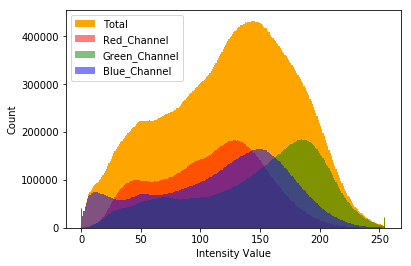
We can also study the color histogram of the image taken by comparing an image taken without a filter and and image taken using the different filter types.
With No Filter:
With Filter #2:
This information is useful in constructing radiation indices for identification of quantifiable objects in an image, which is key in the practice of quantity surveying using remote sensing techniques.
As we can see using the filter the green channel is greatly diminished and we can leverage the amount of Red detected (which is NIR using our filter) with the Blue using our formula to get the modified NDVI, giving a way to quantify the vegetation density in a photographed and/or mapped region.
We can also plot the Red channel (Our NIR) vs the Blue Channel (Our Visible Leverage) to get a characteristic soil and wet edge profile, a kind of correlogram, which is very useful as a remote classification tool.
The data in the scatter plot has a particular pattern however it is really too dense to properly interpret. A solution to this is to create a hexagon bin plot.
we can tidy up our plotting further by using the gaussian kernal density function. This also helps prepare the plot for further study as we shall see.
To begin we need to flatten the data from a 2D pixel array to 1D with length corresponding to elements (Warning! this can take some time). the fastest way to do this is to use the python library-level function ravel, which reshapes the array and returns its view. Ravel will often be many times faster than the similar function flatten as no computer memory needs to be copied and the original array is not affected. *
With added shading we get an easier graph to view and work with overall:
With the ability to place a contour around certain regions of the plot we can then have the ability to link the spectral content with the spacial content in our image analysis.
First we can define a threshold for our NDVI and plot it to see the NDVI levels marked above this threshold if we wish
Next we can place a contour over the spectral region that the threshold mark corresponds to in the NIR vs Blue spectral graph.
We can interpret this ourselves and classify the spectral analysis using established knowledge of its features. This is the beginning of developing a kind of classification system based on this linked information.
We can also classify using other means such as plotting the pixels located between the dry and wet wedges to indicated where mixed vegetation could be.
Going futher down this path leads to exploring other tools such as clustering algorithms, support vector machines, neural networks and the like as we approach the cusp of the field of machine learning with our spectral information which is a valuable technology in and of itself. This deserves its own series of articles with regard to combining drone-based remote sensing with machine vision tools, particularly some of those features in use in the QGIS toolboxes, such as Orfeo.
Interesting still is the fact that indices beyond the NDVI can be developed and studied using these scientific plotting techniques using new filter designs to explore new potential environmental markers. An Ultraviolet-based environmental index using UV-remote sensing cameras is already under development for use in land and marine applications, taking advantage of the ability of UV light to penetrate the air-water barrier and return useful reflectance image information which we will be exploring in the near future.
Code Link: https://github.com/MuonRay/QGISPython/blob/master/NDVIQGISWithMapLegend.py In this video I showcase the creation and use of Near-Infrared (NIR) TIF orthomosaic datasets made using UAV (drone) photography and photogrammetry which can be analysed in QGIS using a Normalised Differential Vegetation Index (NDVI) processing in the Python console in QGIS. This is comparable to the analysis done using satellite imagery, such as Sentinel-2, however using a 4K NIR converted camera on a drone flying at a maximum height of 70 meters means that we can get up to 1cm pixel resolution on the ground, allowing for very accurate remote sensing of areas of interest. QGIS itself a free geomatics software package with a lot of functionality with regards to creating custom code recipes for analysis of datasets acquired using Earth-monitoring satellites and/or drones. There are a lot of interesting add-ons for QGIS, going from simple codes that allow for a cursory editing of a dataset to improve contrast or in more complex applications such as the Orfeo toolbox for machine learning. QGIS, being opensource means that there is large online community of professionals who use its features in research and industry alike and regularly update the different applications of this impressive piece of software. Scripts that run in QGIS are written in Python code with a particular syntax native to QGIS that allows it to call its image processing libraries, which work on TIFs with greater ease than Python standalone scripts alone would and do not create lossy conversions as experienced with Python standalone coding libraries when processing TIF data. There is also options to save the processed images with a defined dpi ratio to preserve the image quality when saving to PNG or JPEG files for viewing completed maps outside of the program. I would highly recommend using QGIS in conjunction with drone imaging and I am eager to explore some of the more in-depth of its applications further, in particular with respect to the classification and potential of the Orfeo machine learning toolbox.
Here is an exercise in 3D image processing I performed using Near-infrared images processed into colormap NDVI, allowing me to create a 3D model of plants for use in 3D plant monitoring/health classification.
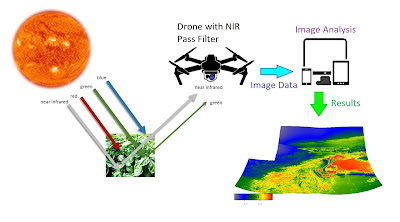
Near-infrared (NIR) reflectance images as described before can carry information about the health of plants, with healthy plant tissue reflecting more strongly in NIR as well as Green.
The NDVI formula leverages the NIR channel with the visibly reflected light, in an NIR converted camera the Red channel becomes NIR and Blue and Green become the visible. The dual-bandpass filter chosen will separate the different color channels, in the case of the filter I use a separation between the blue and NIR regions of the spectrum.Thus In my Python code used to generate the NDVI, the blue channel is leveraged against NIR for more precise close range NDVI.
This was created using (1) custom Python code to process the NIR reflectance images into a graded NDVI temperature scale images and using a combination of (2) VisualSFM for point cloud and polygon generation and (3) Meshlab to tidy up and display the polygon file.
An RGB reconstruction was also performed on a collection of standard images (captured using a phone camera) of the collection of plants scanned for comparison.
The NDVI 3D model was not a perfect reconstruction however it was cleaner in general than the RGB model and considerably faster to process in VisualSFM after the Python code had processed the input RAW (DNG format) images. It is relatively easy to see the distinction between the healthy vegetation and the background environment, the wooden decking, the plants were placed upon in the NDVI 3D model. This has lead me to think that this technique could be further developed in machine vision of plants in an environment in 3D, especially if the 3D model can be converted into a movie using a program like CMPMVS which could then be plugged into a platform such as PyTorch or Tensorflow for use in plant health classification in 3D.In any case this was an interesting way to demonstrate the use of NDVI and NIR imaging as applied in novel applications in the field of 3D photogrammetry and modelling with the intent of creating datasets for future explorations in machine vision research.Code Available Here: https://github.com/MuonRay/PythonNDVI/blob/master/ndvibatch.py
Panorama Stitching, as used in aerial/satellite imaging and space exploration, uses a point matching algorithm (i.e. SIFT) on images taken from a camera then applies a homography transform creating a mosaic composite image. Here Using a 4K NIR Drone Camera we can create HDR NDVI Panoramas using DNG files for input (a JPEG Version is also available).
DNG is the RAW Format used in DJI's Mavic 2 Pro drone and is a data rich file format that requires Python's rawpy library to decode into a form that can be worked with using OpenCV for general image editing generally and panorama stitching specifically in Python. It is hoped that this coding project will be a less computing intense solution to generating NDVI diagnostics of the environment without the need for expensive or computationally intensive processing such as creating 3D orthomosaics or photogrammetry files which can be relatively more daunting to produce and work with as compared to a panorama.
Essentially any images acquired using a Near-Infrared (NIR) converted camera can be used to generate a modified Normalized Differential Vegetation Index (NDVI). The coding contains standalone colorbar legend and is a batch processing version that works with all DNG files in the working directory. ENDVI and SAVI Indexes also available and with greyscale options. in the larger Python NDVI GitHub project folder. I also encourage open modification and tinkering of this projects code for improving this field of exploration and environmental examination.
I have also included a selection of custom developed python codes for use in various drone imaging applications, such as batch conversion of DNG (RAW) drone images to JPEG or PNG, use of the rawpy library features of demosaicing, gamma factor correction and use of skimage library to demonstrate histogram equalization in colour images to create better contrast and depth. This repository also increases coding developed for use in generating panorama composite images both in JPG and DNG format, a very useful technique in high definition aerial imagery. These codes are open for use in educational and demonstration uses and for non-profit organisations. See here:https://github.com/MuonRay/Drone-Image-Editing-in-Python-Coding-Repository
Here is a short video showing how I use Camera Raw in Adobe Bridge to generate Drone Panorama images quickly and easily with or without opening Photoshop. The advantages processing in Adobe Bridge offers is that it can improve the speed and efficiency of stitching together large images in panorama without slowing down your computer significantly.
Photoshop, like all programs, uses up some of your computer's resources while it's open. Even if you're not working in Photoshop at the time, as long as it's open in the background, it's still using up resources. If you're working on a slower computer to begin with, having programs open in the background that you're not using can slow you down even more.
Camera Raw offers such a complete image editing environment that it's entirely possible to do everything you need to do with your photo in Camera Raw without ever needing to open it in Photoshop for further editing, including cropping, aligning, contrast and color channel editing. Camera Raw is perfectly capable of running in Bridge itself, or another way to put it, Camera Raw can be "hosted" by Bridge, just like it can be hosted by Photoshop.
Another benefit to running Camera Raw from Bridge, and one that has an impact on your workflow, is that when you're finished processing one image in Camera Raw and click the Done button to close out of it, you're instantly returned to Bridge, ready to select and open the next image or sets of images for further processing.
This is an urgent message, so lets not waste time with introductions.
The Government of Ireland must mandate a Complete Shutdown of all non-essential and non-medical business immediately. This means closing all non-essential manufacturing, factories, construction sites, call centers and non-essential warehouse work (excepting medical device, food services for humans and animals, pharmaceuticals and other essentials) - Private and Multinational firms that are still continuing business as usual in Ireland MUST BE CLOSED - They must not be allowed to continue work as they dictate until they chose to close. WE ARE IN A NATIONAL CRISIS AND THEY MUST BE MANDATED TO CLOSE. I RECOMMEND THAT AS MANY PEOPLE AS POSSIBLE USE THIS POST AS A PLATFORM TO NAME AND SHAME PRIVATE COMPANIES IN THE REPUBLIC OF IRELAND THAT ARE REFUSING TO CLOSE AND PUTTING THE LIVES OF OUR CITIZENRY AT RISK AND ARE MORTGAGING THE FUTURE OF LIFE AS WE KNOW IT FOR SHORT-TERM PROFIT. The numbers of people out on the streets, parks, beaches and other public environs is also alarming. In the UK it is now illegal to be out during a nationwide lockdown while in Ireland we have still not made measures to ENFORCE SOCIAL DISTANCING THAT CAN SAVE HUNDREDS IF NOT THOUSANDS OF LIVES.
Despite many euphemisms and mitigating measures the government has taken they have been half-measures at best and will do nothing to FLATTEN THE INFECTION CURVE. WE MUST MOVE PAST HALF-ASSED MITIGATION AND HAVE A FULL LOCKDOWN, APPLY "THE HAMMER" - Only then can we move onto "THE DANCE" AND CAREFULLY RESTART OUR COUNTRY AGAIN. The key word here is MITIGATING MEASURES. the government refuse to take any hardline measures to, in-effect, flatted the infection from an exponential rate to a linear rate and eventually reaching a level that will not overwhelm our already beleaguered healthcare system.
We have healthcare workers who can only be considered superheroes at this point who are quickly becoming so overwhelmed that they are, in-effect, samurai in nurses and doctors clothing. They are risking their own lives and also having to take the extra burden and risk because, again PRIVATE BUSINESSES REFUSE TO CLOSE ON THEIR OWN! THEY MUST BE FORCED RIGHT NOW! TIME IS KEY IN ALL OF THIS. WE MUST GET OUR COUNTRY FROM AN EXPONENTIAL STAGE OF INFECTION RATE TO A LINEAR STAGE AND FLATTEN THE CURVE. WE CAN ONLY DO THIS WITH A FULL LOCKDOWN FOR AT LEAST 2 WEEKS! To citizens I recommend you STAY INDOORS AS LONG AS POSSIBLE, we can only fight this virus and stop it becoming a permanent part of the microbial ecosystem in this country if we band together on this and most importantly HOLD BUSINESS AND GOVERNMENT TO ACCOUNT! DON'T FORGET THAT THEY SHOULD HAVE HAD A WUHAN OR RUSSIAN STYLE LOCKDOWN AT LEAST A WEEK AGO IF NOT TWO! THE DATA DOES NOT LIE - The John's Hopkins Website has been providing more up to date information than any of the highly funded and subsidized quangos and institutions in IRELAND. The most important detail is to read the shape of the graph, not merely quote numbers. This is Our Status (March 26th 2020):
WE ARE HEADING INTO EXPONENTIAL GROWTH. WE MUST ACT NOW! Compare this to Italy, the Worst Country Hit in Europe:
EXPONENTIAL INFECTION RATE HAS CAUSED THE VAST NUMBER OF DEATHS WITHIN ITALY. SEE John's Hopkins COVID 19 Updates live here: reading the curve is far more essential than the individual numbers: https://coronavirus.jhu.edu/map.html The Ideal is to APPLY THE HAMMER, initiate a 2 week controlled lockdown and flatten the infection rate, as CHINA and most East Asian Countries have done:
WE HAVE BEEN TOLD CONSTANTLY BY THE IRISH GOVERNMENT AND THE MAINSTREAM MEDIA (RTE Are most culpable) THAT THE WORD "LOCKDOWN" IS A SCARE TACTIC. WELL, IN TIMES LIKE THIS FEAR WORKS TO GET THE JOB DONE. WE DON'T HAVE TO BE AFRAID FOREVER BUT THIS CRISIS REQUIRES US TO REALLY BE AFRAID FOR OUR LOVED ONES AND FOR OURSELVES. Morever, it has not been the word "lockdown" that the citizenry have had a hard time understanding: The term "Social distancing" has been apparently interpreted by the public with a mixture of confusion and reckless abandon, maybe because it was written by the same second-rate advertising gurus that write the script our politicians read. As the Comedian George Carlin once said "Euphemisms are bullshit, people need direct honest language" - So, my fellows, please STAY INDOORS FOR AS LONG AS YOU HAVE FOOD AND MEDICINE!
Again, to the Government, INITIATE A CLOSURE OF NON-ESSENTIAL PRIVATE BUSINESSES TO ENSURE THAT WE FLATTEN THE INFECTION RATE! YOU WILL BE HELD ACCOUNT FOR THIS NEGLIGENCE!
We can hopefully look back on this moment and perhaps laugh and have a kind of "I was there" moment with the kids in the future. Perhaps. But if we do not act now we are going to plunge this country into loss and sorrow that will take generations to heal. Please do what is in the common good. IMPORTANT NOTE: As I write this America has overtaken every other country as the most heavily infected. this was not unexpected given the delayed response there however they are due to get much worse due to the high level of exponential growth leading to a great strain on their healthcare system:
This project involves creating vibrant etching artwork using ultraviolet reactive perspex in a Luminescent Solar Concentrator (LSC) configuration with silicon thin film solar panels on the side to harvest light as energy, boosted using an energy harvester circuit designed for indoor solar energy harvesting.
This technology was developed over a few years and has been tested using many different designs. The concept of using solar concentrators in buildings (in windows, roofing, glasshouses etc) has been explored in many research scenarios however the development of indoor based light-energy harvesting for display use is something that is novel in the context of use in displaying artwork.
UV artwork is very interesting and the vibrancy in certain UV reactive materials adds a contrast on images within the environment they are placed that is not found in other display media. The UV light source does not need to be super-bright and often the display is more effective in an environment where lighting is kept at a minimum to bring out the sharper colors from the fluorescence. Many museums are using this technique to create interesting and eye catching displays for unique visual experiences. In some situations it resembles Neon lighting however it is far more energy efficient and safer to install.
Introduction:
The installation of conventional photovoltaic (PV) solar cells have many advantages. The ease of installation, the ability to generate energy locally and with minimal investment and supervision makes them ideal to install on buildings and integrate within devices.They can be used on rooftops, most portable solar chargers and in other applications directly absorb sunlight and convert it into electricity.
The major drawback is that amount of power, in watts, conventional solar cells can harvest is dependent on the amount of area the cells cover. So in areas where surface area is a premium, PV solar has clear limits in its energy harvesting capacity. High rise cities for example do not have the space for all but the most superficial of solar energy installations. This is a fundamental problem for genuinely running an energy hungry city on energy harvested directly from the environment.
Electricity is generally consumed first at the source where it is generated. So energy producing installations if positioned far from a cityscape will have their transmitted power drawn from other sources first, such as small towns and villages, and ultimately creates a situation where prioritization of power distribution is backwards - effectively powering the small municipalities before the larger ones.
Accounting for losses in transmission over large distances also means it makes sense to position a power plant as close to a city as possible. This is not so much a problem with stored fuels, such as fossil fuels, which can be stored and converted to electricity in power stations that require less space and are thus possible to install near large cities. With generic renewable energy however, large amounts of space is required, be it wind farms or solar arrays, so it is not really practical to position it near a city for the reason described and certainly not within it, only in a superficial sense such as on rooftops, as city high rises inevitable lead to shading of the surface.
Conventional PV solar cells made of high quality materials, from Silicon to CIGS, will require refinement, purification, cleaning, doping and deposition and this will naturally increase their expense as the power they are expected to generate, and thus size, increases in demand. So even with conventional photo-voltaic solar cells we are trapped in the process in which the more power we want to harvest, the more money we will have to invest, making the transition to solar energy an expensive one.
This does not even go into mentioning that the most efficient photovoltaic absorption materials known, such as Gallium Arsenide (which has benefits of being a radiation-hard material) and perovskite photovoltaic materials are extremely expensive.
Concentrating and Harvesting Solar Energy
Methods of concentrating solar energy, such as using reflective mirrors and/or lenses offers an obvious solution to the problem. However concentrating solar energy using conventional methods often means that we must have more supervision and infrastructure available in an area. For example, concentrating solar energy by mirrors and/or lenses is often done by heating water in a power plant infrastructure which may not always be available in a local area and will require yet more investment.
Moreover, different technologies are required to harvest the concentrated solar energy - i.e. using Stirling engines, thus creating technology barriers along with the economic cost on transitioning to solar energy.
Therefore it would be nice if we were able to use combine the ability to harvest solar energy using conventional solar cells with new approaches to concentrating solar energy. One such approach is the idea to concentrate the solar energy by "pumping" a fluorescent medium with sunlight, akin to how a laser crystal can be pumped with a flashlamp, in which by clever design of the fluorescent medium and optics, the photon population in the flourescnt medium can be concentrated to a large level which can then be delivered to the PV cell.
This is the idea behind the operation of a Luminscent Solar Concentrators or LSC. A LSC absorbs the light on a plate embedded with highly efficient light-emitters called “lumophores” that then re-emit the absorbed light at longer wavelengths, a process known as the Stokes shift. For example, absorbing UV radiation to produce visible light. This re-emitted light is directed by total internal reflection (just like an optical fiber) to a micro-solar cell for conversion to electricity. Because the plate is much larger than the micro-solar cell, the solar energy hitting the cell is highly concentrated.
With a sufficient concentration factor, only small amounts of expensive photovoltaic materials are needed to collect light from a potentially inexpensive luminescent waveguide. The waveguides could be in principle made to be integrated into double-glazed glass windows, thus providing a possible solution to the integration of energy harvesting within high rise cities and across all available dimensions of a building.
Even within a building, in locations where sunlight reaches on walls the concentration of light to generate moderate amounts of energy can be achieved, at the very least for lighting.
Now why would this be important to consider? Well, LSCs have not only the potential to provide a means to Stokes-shift shorter wavelengths, such as UV, into longer ones such as red and blue, but also to provide a means to upconvert longer wavelengths of light, such as infrared, which is not converted to electricity by the PV material into shorter wavelengths such as red.
A large portion of radiation emitted by the Sun itself is in infrared and only generates waste heat in a PV cell, which undermines its overall performance. So developing materials that do demonstrate upconversion of infrared light, from IR lasers, is a reasonable step to developing devices that will work outside of the lab, perhaps using sunlight or alternatively as a way to provide wireless power distribution by means of lasers. Energy distribution by means of lasers, such as the common GaN UV Lasers, may also be possible to demonstrate with such a system..
This project, its images and design was developed by MuonRay Enterprises Ireland for educational purposes.
Artworks Depicted
In this project I created several etchings as a demonstration of how etching UV Perspex on different layers with contrasting colors can create very vivid and sharply colored images, not to mention the inclusion of a mirror which gives the images a sort of "floating pseudo-hologram effect". I will share the images depicted in the video and explain what they are from. All are cultural and historical symbols that I find interesting.
A mythical dragon, somewhat inspired by oriental dragons but I was thinking more along the lines of Lewis Carroll's Jabberwock when I was designing it - "with eyes of flame!"
The Winged Disk - The winged sun is a symbol associated with divinity, royalty and power in the Ancient Near East in particular the Old Kingdom of Ancient Egypt where it was used both to represent the Gods Ra and Horus.
A Celtic Knot Moon in conjunction with a Celtic Spiral Sun. The Celtic Knot is sometimes a depiction of a universe forever in flux but without clear beginning or end either in scale or direction. The Spiral Trigram is commonly associated with the connection between the changing seasons, death, life and rebirth. All are a common motif in Ancient Irish Culture.
The 4 Treasures of the Tuatha Dé Danann, a supernatural magical race in Irish mythology who bore these magical artifacts, crafted in faraway islands beyond Ireland. They are thought to be a pantheon of demigods or precursors to the main deities of pre-Christian Gaelic Ireland. In my depiction of the 4 Treasures, I symbolise each with one of the 4 classical elements of antiquity.
Claíomh Solais (The Sword of Light) - A Magical Sword that when swung no person could escape it. This sword is often associated with Nuada the King of the Tuatha Dé Danann, with him sometimes given the epithet Airgeadlámh, meaning "silver hand/arm". The element I have associated it with is fire.
Cauldron of Dagda - Dagda was one of the Tuatha De Dannan and later on the Irish All Father associated with fertility, agriculture, strength, as well as magic, druidry and wisdom. He is strongly associated with the culture at the Brú na Bóinne (Newgrange). From His cauldron it is said nourishment flows from which nobody is ever left hungry or weak. The element I have associated it with is water.
Lia Fáil (Stone of Destiny) - This is the ancient Coronation stone from which the High King's and Queens of Ireland would be deemed fit to rule the country by the stone itself vibrating. The an ancient stone still sits on the Hill of Tara to this day, however whether or not this is the true one remains unknown. The element I have depicted with this treasure is Earth with plant like roots boring into the ground from the stone to add to the effect and also the name of the stone itself etched in Ogham.
The Spear of Lugh - Lugh is a God of many talents in Irish mythology. He was a master craftsman but also a warrior and in some depictions both a messenger and a trickster. Lugh is linked with the harvest festival of Lughnasadh, which bears his name. He was also attributed to storms and so I have depicted his weapon of choice, a spear, with lighting and attribute it as the element of air. When Lugh uses his spear, it is said that it brings a decisive end to all conflict.
This symbol is the Hamsa Hand, also known as The Hand of Miriam (Sister of Moses) in Jewish Tradition and also known as The Hand of Fatima in Islam and to a less common extent as the Hand of Mary in Christianity. There is also history of its use much earlier in Ancient India. In general it is used as a protective talisman. It is a symbol that people believe can protect them from harm against the evil eye and bring them goodness, abundance, fertility, luck and good health. In my travels I have seen it quite commonly used on ships in the Middle East as a charm to ward off storms.
With this one I used 3 layers of UV reactive perspex to reasonable effect at creating a vibrant display of color.
This project has been a fun way to share the concept of using perspex to create efficient illuminated artwork that can power itself and remain functional without external power sources. The technique in developing the art has been a learning experience for me and I hope to create more artwork using this technique in the future.